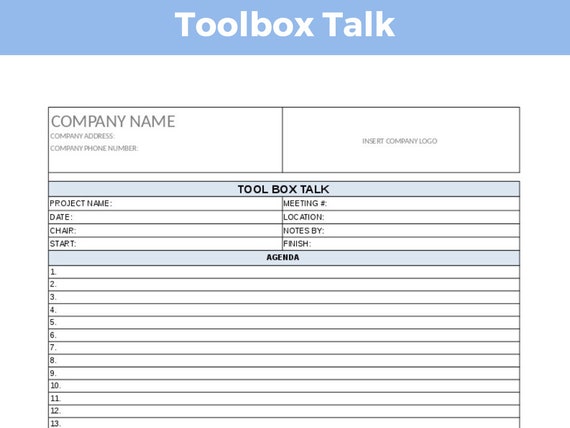
Safety doesn’t happen by accident—neither does effective communication. On active job sites, where conditions shift hourly and hazards evolve, the daily toolbox talk is one of the most powerful tools a supervisor has. But without a clear, adaptable structure, these conversations become inconsistent, forgotten, or reduced to a box-ticking exercise. That’s where a blank toolbox talk template becomes essential.
A well-designed template ensures consistency, encourages engagement, and creates a documented trail of safety efforts. More importantly, it turns routine check-ins into meaningful discussions that workers remember—and act on.
This guide delivers a practical, editable blank toolbox talk template, explains how to use it effectively, and highlights common pitfalls that undermine even the best-intentioned safety programs.
Why a Blank Toolbox Talk Template Matters
Toolbox talks are short, focused safety meetings—usually 10 to 15 minutes—held at the start of a shift or before a specific task. They’re designed to address immediate hazards, reinforce procedures, and engage frontline workers in safety decisions.
Without a structure, these meetings often lack direction. Supervisors might skip them under time pressure, or default to generic warnings like “wear your PPE.” A blank toolbox talk template solves that by providing a consistent framework that’s easy to customize.
The best templates are simple but thorough. They prompt the leader to:
- Identify the topic clearly
- Outline specific hazards
- Describe controls and best practices
- Confirm understanding with the team
- Record attendance and signatures
This isn’t about bureaucracy—it’s about accountability and clarity. In regulated industries like construction, manufacturing, and utilities, documented talks also support OSHA compliance and incident investigations.
Essential Elements of a Blank Toolbox Talk Template
An effective blank template isn’t just a checklist. It’s a communication tool designed for real-world use. Include these core components:
#### 1. Header Information Start with basic project and meeting details: - Date and time - Job site location - Supervisor or safety lead - Project name or number - Weather conditions (if relevant)
This creates context. A talk about working at heights in high winds needs different emphasis than one on a calm, controlled interior site.
#### 2. Topic and Objective Define the focus clearly. Instead of “Safety Reminder,” use “Preventing Back Strain During Manual Lifting.” Specificity improves retention. Example: > Topic: Safe Use of Extension Ladders > Objective: Ensure all workers know the 4-to-1 rule, inspection points, and proper securing methods.
#### 3. Hazard Identification List 2–4 real hazards related to the topic. Avoid vague terms. Instead of “fall risk,” say: > - Ladder placed on uneven ground > - Top section extended beyond safe limit > - No spotter during setup
This trains workers to think critically about their environment.
#### 4. Controls and Best Practices Pair each hazard with a clear action. > - Always inspect ladder for cracks or loose rungs before use > - Maintain 3-point contact while climbing > - Secure top and bottom before ascending
Use active language. Workers respond better to “Do this” than “Avoid that.”
#### 5. Discussion Prompts Include 1–2 open-ended questions to spark engagement: > - “Has anyone seen a near-miss with ladders this week?” > - “What’s one thing we can do better when storing ladders overnight?”
These transform monologue into dialogue, increasing buy-in.
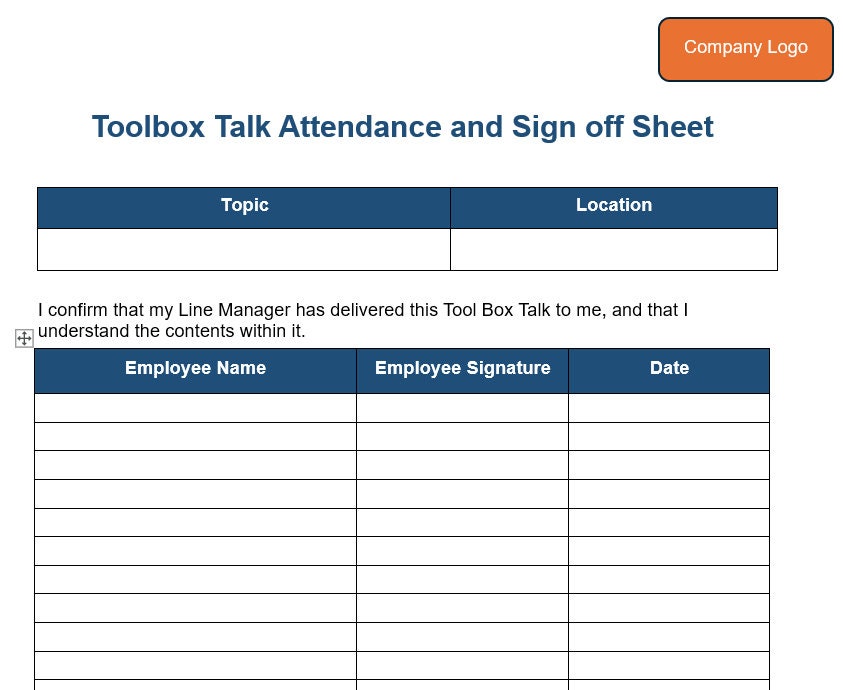
#### 6. Attendance and Sign-Off List space for names, roles, and signatures. Digital or paper, this proves participation. Tip: Rotate who leads the talk weekly. It builds ownership and develops safety leadership at all levels.
Real-World Example: Using the Template
Imagine a roofing crew preparing for a day of ridge cap installation. The supervisor pulls out the blank template and fills it in:
Date: April 10 Location: 245 Oak Street, Roof Level Lead: James Rivera Project: Oak Street Roof Replacement
Topic: Working Safely Near Roof Edges Objective: Reinforce fall protection use and edge awareness
Hazards: - Unprotected roof edges with no guardrails - Slippery surface due to morning dew - Tools left near edge risking drop hazards
Controls: - 100% tie-off required with harness and lanyard - Use tool lanyards for all hand tools - Establish a 6-foot “no-go” zone near open edges unless protected
Discussion Questions: - “What’s your signal if you need to cross an unprotected area?” - “Who checks that harnesses are inspected weekly?”
- Attendees:
- Marcus T. – Roofer – [Signature]
- Lena P. – Roofer – [Signature]
- ...
This talk takes 12 minutes. Workers leave knowing exactly what’s expected and why. If OSHA visits tomorrow, the documentation is ready.
Common Mistakes That Undermine Toolbox Talks
Even with a great template, poor execution kills effectiveness. Avoid these traps:
#### ❌ Reusing the Same Topic Monthly Cycling through “PPE” or “Hydration” every month breeds complacency. Workers tune out. Refresh topics based on current work, incidents, or seasonal risks.
#### ❌ Skipping Signatures No record = no proof. Signatures aren’t about surveillance—they’re proof of shared responsibility.
#### ❌ Leading from Memory, Not the Template Even experienced supervisors miss points under pressure. The template ensures nothing gets dropped.
#### ❌ Ignoring Worker Input If only the supervisor talks, it’s not a toolbox talk—it’s a lecture. Use the discussion section to invite feedback.
#### ❌ Holding Talks Too Late If the crew is already on tools, the message misses its window. Schedule talks before work begins.
How to Customize the Template for Different Industries
The same blank template works across sectors with minor adjustments:

#### Construction Focus on fall protection, equipment use, and site-specific hazards. Add sections for crane lifts or confined space entry when relevant.
#### Manufacturing Emphasize lockout/tagout, machine guarding, and ergonomics. Include shift handover notes.
#### Utilities Highlight electrical safety, arc flash boundaries, and communication protocols during outages.
#### Landscaping Address heat stress, equipment transport, and underground utility awareness.
The core structure remains. Only the content changes.
5 Free & Editable Blank Toolbox Talk Template Resources
You don’t need to build from scratch. These reliable sources offer customizable, professional templates:
| Resource | Format | Key Features | Best For |
|---|---|---|---|
| OSHA.gov | PDF, DOC | Government-vetted, OSHA-aligned | Compliance-focused teams |
| SafetyCulture (iAuditor) | Digital, Web | Mobile-friendly, cloud storage | Companies going paperless |
| Creative Safety Supply | DOCX, PDF | Clean layout, multilingual options | Quick printing and use |
| SafetyInfo.com | DOC | Large library of pre-written topics | Teams needing plug-and-play content |
| HSI (Health & Safety Institute) | Editable PDF | Built-in compliance tracking | Training integration |
All are free to download and adapt. Choose one that fits your workflow—paper-based, digital, or hybrid.
Turning the Template into a Living Safety Tool
A blank toolbox talk template is only as good as its use. To maximize impact:
- Schedule in advance. Plan topics weekly based on the work schedule.
- Store talks centrally. Use binders, shared drives, or EHS software.
- Review past talks after incidents. Did a recent fall exposure align with a past discussion?
- Train leads to facilitate, not lecture. Good safety leaders ask questions, listen, and respond.
- Audit your talks quarterly. Are topics relevant? Is attendance consistent?
When used consistently, the template becomes more than paperwork—it becomes part of the safety culture.
A blank toolbox talk template is simple, but its impact is profound. It turns safety from an abstract goal into a daily practice. It gives every worker a voice and every supervisor a clear method.
Download a template today. Fill it out tomorrow. And make sure every job starts with a conversation that matters.
Frequently Asked Questions
What should be included in a toolbox talk template? A complete template includes date, location, topic, hazards, controls, discussion questions, and attendee sign-offs.
How long should a toolbox talk last? Aim for 10 to 15 minutes. Focus on one topic to keep it concise and actionable.
Who should lead a toolbox talk? Typically a supervisor or safety officer, but rotating leads builds broader engagement.
Are toolbox talks required by OSHA? OSHA doesn’t mandate them by name, but they support compliance with training and communication requirements.
Can I use a digital toolbox talk template? Yes. Many teams use apps or tablets for real-time documentation and storage.
How often should toolbox talks be held? At least weekly, or daily on high-risk sites. Frequency should match job complexity and hazard level.
Do all workers need to sign the template? Yes. Signatures confirm attendance and understanding, and support compliance efforts.
FAQ
What should you look for in Blank Toolbox Talk Template for Any Job Site? Focus on relevance, practical value, and how well the solution matches real user intent.
Is Blank Toolbox Talk Template for Any Job Site suitable for beginners? That depends on the workflow, but a clear step-by-step approach usually makes it easier to start.
How do you compare options around Blank Toolbox Talk Template for Any Job Site? Compare features, trust signals, limitations, pricing, and ease of implementation.
What mistakes should you avoid? Avoid generic choices, weak validation, and decisions based only on marketing claims.
What is the next best step? Shortlist the most relevant options, validate them quickly, and refine from real-world results.