Construction sites in the UK operate under intense scrutiny—not just from clients and regulators, but from the ever-present risk of injury. Despite improvements in safety standards, HSE reports consistently show that slips, falls, and equipment misuse remain leading causes of workplace incidents. Toolbox talks are one of the most effective tools to combat this. Short, focused, and timely, these discussions keep safety top of mind. But to be effective, they must address real risks with practical relevance.
Too often, toolbox talks become routine box-ticking exercises—generic, repetitive, and quickly forgotten. The difference between a talk that changes behaviour and one that’s ignored lies in topic selection. The right topic resonates with the team, matches site conditions, and aligns with UK legal obligations under the Health and Safety at Work Act and CDM Regulations.
Below are the most impactful toolbox talk topics for UK construction and industrial environments—curated for relevance, compliance, and real-world application.
Why Specificity Matters in UK Toolbox Talks
A generic “slips and trips” talk won’t cut it if your team is working on a wet concrete pour at height. Relevance determines retention. The best toolbox talks are time-bound, location-specific, and linked to immediate tasks.
For example, discussing ladder safety on a day when operatives are installing roof lights is far more impactful than delivering the same talk during ground-level groundwork. UK sites vary widely—from urban high-rises to remote infrastructure projects—and so should the content.
The HSE recommends that toolbox talks: - Last 5–10 minutes - Be documented - Involve the entire crew - Address actual site hazards
Generic topics fail because they don’t pass the “so what?” test. Workers need to walk away knowing exactly what to watch for—and how their actions affect safety outcomes.
1. Working at Height: The Leading Killer on UK Sites
Falls from height account for nearly 30% of construction fatalities in the UK. Despite clear regulations under the Work at Height Regulations 2005, lapses in planning and equipment use remain common.
A targeted toolbox talk should cover: - Correct harness use and inspection - Guardrail installation and limitations - Fall arrest vs. fall restraint systems - Weather impact on edge protection
Real-world example: On a London high-rise project, a near-miss occurred when a worker stepped onto an unsecured scaffold plank. The follow-up toolbox talk didn’t just restate rules—it showed photos of the incident, discussed human factors (complacency, time pressure), and had each team member inspect their harness.
Common mistake: Assuming that using a harness equals compliance. In reality, improper anchoring or lack of rescue planning renders PPE ineffective.
Workflow tip: Use the “Three Points of Contact” rule during briefings—every worker must identify where their three points (two hands, one foot or vice versa) will be when moving at height.
2. Manual Handling: Still a Top Cause of Injury
Over a quarter of non-fatal injuries in construction involve manual handling. Yet many teams treat it as low risk because it rarely makes headlines.
An effective talk should go beyond “bend your knees.” Focus on: - Load assessment: weight, shape, grip - Team lifting protocols - Use of mechanical aids (trolleys, hoists) - Long-term musculoskeletal risks

Use case: On a retrofit project in Manchester, workers were shifting heavy insulation boards. The supervisor ran a 7-minute talk showing proper team lift formation, marking load weights on packaging, and assigning a spotter. Reported back strain incidents dropped by 60% over the next month.
Limitation: Not all tasks can be fully mechanised. The talk must acknowledge physical limits and encourage early reporting of discomfort.
3. Electrical Safety on Live and Nearby Circuits
UK sites frequently encounter live electrical systems, especially during refurbishments. The Electricity at Work Regulations 1989 require strict controls, but confusion persists around safe distances and isolation procedures.
Key points to include: - The 600V rule: minimum approach distances - Lockout-tagout (LOTO) procedures - Use of voltage detectors and PPE - Reporting damaged cables or temporary supplies
Practical example: A team in Birmingham was rerouting lighting in an old factory. The toolbox talk included a demonstration of how to verify isolation using a two-pole voltage detector. Workers were tested on the spot—only those who passed were allowed to proceed.
Common error: Using multi-meters instead of dedicated voltage testers. Multi-meters can fail to detect voltage in certain fault conditions.
4. Hazardous Substances and COSHH Compliance
From sealants to diesel fumes, construction workers face daily exposure to hazardous substances. Under COSHH regulations, employers must assess and control these risks.
A strong COSHH-focused toolbox talk should: - Identify substances in use that day - Review safety data sheets (SDS) - Demonstrate correct PPE (respirators, gloves) - Show emergency procedures for spills
Real scenario: A tiling crew in Glasgow was using an adhesive with isocyanates. The supervisor used the talk to explain respiratory risks, demonstrated fit-testing for FFP3 masks, and reminded workers of the 15-minute exposure limit.
Tip: Rotate responsibility—assign a different worker each week to review the SDS of a material and present key risks to the team.
5. Plant and Vehicle Movement in Confined Areas
With 70+ vehicle-related fatalities annually in UK construction, site traffic is a critical topic. Visibility, signage, and communication gaps are common failure points.
Focus areas: - Banksman responsibilities and hand signals - Blind spot awareness for operators - Separation of pedestrians and vehicles - Use of proximity detection systems
Use case: On a congested housing development in Leeds, a near-collision between a dumper truck and a labourer prompted a site-wide talk. The session included a practical demo of blind zones using cones around an excavator.
Checklist for every vehicle talk: - ✅ Banksman wearing high-vis and using standard signals - ✅ Pedestrian routes clearly marked - ✅ Reversing alarms functional - ✅ All operators briefed on site rules
6. Fire Safety and Hot Work Permits
Hot work—welding, grinding, cutting—is responsible for 10% of construction fires. Under the Regulatory Reform (Fire Safety) Order 2005, risk assessments and permits are mandatory.
Toolbox talks must: - Confirm permit is issued and displayed - Identify fire watch roles - Show location of extinguishers and assembly points - Check for combustible materials nearby
Example: A steel erection team in Newcastle conducted a pre-welding talk that included clearing a 10m radius of debris, assigning a fire watcher with a radio, and testing the extinguisher on site. A spark later ignited insulation—fire was contained in under 30 seconds.
Key message: A hot work permit isn’t paperwork—it’s a live safety plan.
7. Personal Protective Equipment (PPE): Beyond the Basics

PPE is visible, but misuse is widespread. Wearing a hard hat doesn’t help if the chinstrap isn’t secured or the shell is cracked.
Topics to stress: - Daily inspection routines - Compatibility (e.g., goggles with hard hats) - Limitations of PPE (it’s the last line of defence) - Site-specific rules (e.g., mandatory hearing protection in certain zones)
Common mistake: Workers wearing ear defenders incorrectly—folded over the head instead of forming a seal. A quick 2-minute demo during a talk corrected widespread misuse.
Pro insight: Use damaged PPE as visual aids. Show a cracked helmet or torn glove—make the risk tangible.
8. Environmental Conditions: Heat, Cold, and Weather
UK weather is unpredictable, but its impact on safety is often overlooked. Cold reduces dexterity. Heat leads to fatigue and poor decisions.
Talks should address: - Hydration and rest breaks - Recognising signs of hypothermia or heat stress - Adjusting work patterns (e.g., shifting heavy tasks to cooler hours) - Use of weather-appropriate clothing
Real incident: A worker in Yorkshire collapsed during a heatwave. The follow-up talk included a printed table of symptoms vs. actions (e.g., dizziness = immediate rest and water). Supervisors were given laminated cards to carry.
Practical tip: Tie weather talks to the forecast. If rain is expected, discuss slippery surfaces and electrical equipment.
Making Toolbox Talks Stick: Best Practices
Even the best topic fails without delivery discipline. Follow these rules:
- Keep it short: 10 minutes max. Respect workers’ time.
- Involve the team: Ask questions, get feedback, name risks.
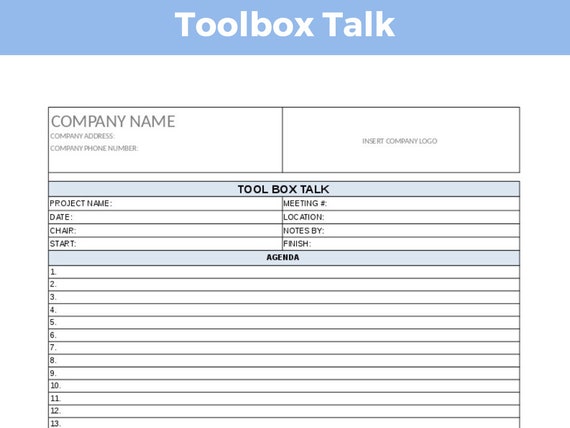
- Document it: Sign-in sheets with topic, date, and attendees.
- Use visuals: Photos, props, or sketches increase retention.
- Rotate presenters: Builds ownership and engagement.
Avoid reading from a script. Instead, start with a question: “What’s the biggest hazard we face today when working on the first floor?”
Conclusion: Choose Topics That Match Your Site, Not a Template
The most effective toolbox talks aren’t pulled from a generic list—they’re built from real site conditions, recent incidents, and upcoming tasks. In the UK, where HSE inspectors can request talk records during audits, relevance and documentation are not optional.
Pick one of the topics above that aligns with your current work. Run it with focus. Use a real example. Demand engagement. Then document it. Do this consistently, and you won’t just comply—you’ll change safety culture.
FAQ
What are the legal requirements for toolbox talks in the UK? While not explicitly mandated by law, toolbox talks are a recognised method of meeting duties under the Health and Safety at Work Act and CDM Regulations, particularly around information, instruction, and training.
How often should toolbox talks be held? At least weekly, or whenever there’s a new task, hazard, or near-miss. Daily talks are common on high-risk sites.
Who can deliver a toolbox talk? Supervisors, site managers, or competent operatives—anyone with knowledge of the topic and authority to enforce safety rules.
Should toolbox talks be recorded? Yes. HSE may request evidence of safety communication. Maintain sign-in sheets with topic, date, attendees, and key points.
Can toolbox talks reduce accident rates? Yes—when relevant and interactive. Sites with consistent, high-quality talks report fewer incidents and better safety ownership.
Are toolbox talks only for construction? No. They’re used in utilities, manufacturing, and maintenance—any sector with dynamic hazards.
What’s the difference between a toolbox talk and a safety briefing? Toolbox talks are shorter, topic-specific, and often informal. Safety briefings may cover broader site updates and are usually longer.
FAQ
What should you look for in Top Toolbox Talk Topics for UK Construction Sites? Focus on relevance, practical value, and how well the solution matches real user intent.
Is Top Toolbox Talk Topics for UK Construction Sites suitable for beginners? That depends on the workflow, but a clear step-by-step approach usually makes it easier to start.
How do you compare options around Top Toolbox Talk Topics for UK Construction Sites? Compare features, trust signals, limitations, pricing, and ease of implementation.
What mistakes should you avoid? Avoid generic choices, weak validation, and decisions based only on marketing claims.
What is the next best step? Shortlist the most relevant options, validate them quickly, and refine from real-world results.